The reference work is a 3D, software-generated, real-time animation: 60 times per second, an image is produced by the execution of lines of code employing the computer’s graphic processor.
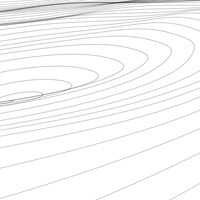
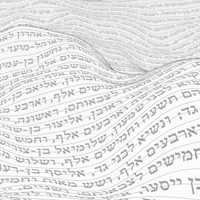
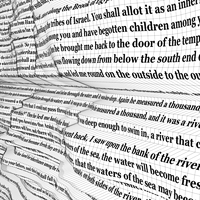
The visuals are made solely of text, lines and shaded surfaces, as revealed in the 5 mini demos.
procedural water
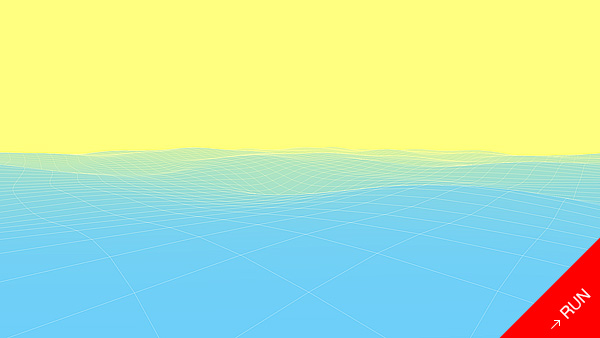
Water surface is simulated by superimposing a series of sinusoidal waves. While all the wave trains share the same period, each one travels in a different direction, with its own amplitude and wavelength.
This relatively simple technique is used to simulate deep-water waves, with no effect from the ocean floor (e.g. breaking waves) and without interferences (e.g. refraction effects near the coast.)
procedural desert
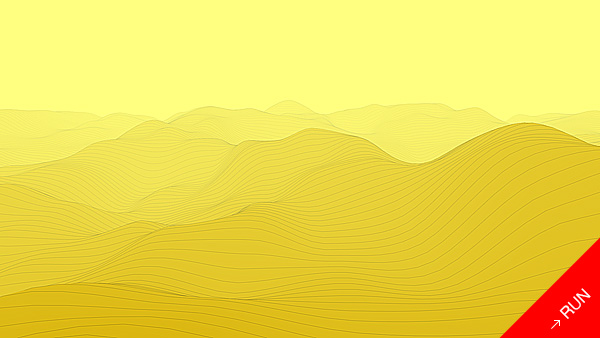
At the base of most procedural terrain generation techniques lies a 2D grid whereon each point is assigned a particular elevation.
In our case, the height-map is generated using Perlin Noise, which produces random yet locally harmonic values. The generated data is then sampled transversally to produce continuous curves that in turn will serve as support for text.
procedural cliffs
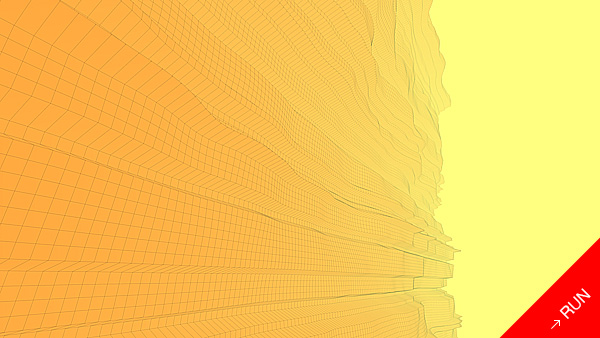
As for the desert, the cliffs are generated using Perlin Noise, with various parameters and with the additional effect of posterization.
Perlin Noise (originally developed in the early 1980s to generate textures for the movie Tron) is widely used in computer graphics whenever reproducing patterns found in nature (mountains, clouds, smoke, fire, fur…) is required.
infinite text-field / fly
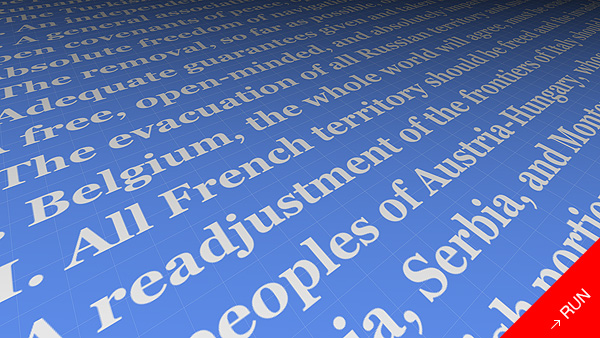
Text is classically laid out in lines forming horizontally-bounded columns. New solutions had to be invented in order to provide the full-coverage of a surface while retaining the text's meaning.
The system used here enables transforming any piece of text into an infinite text-field, readable on both horizontal and vertical axes.
Demonstration of the principle using President Wilson's 14 points as textual source…
infinite text-field / flow
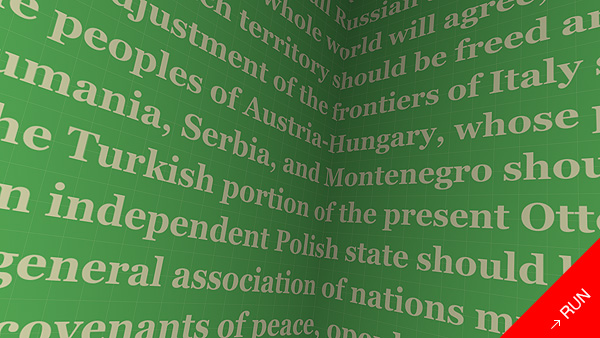
Elaborating on the previous example, it is possible to split an infinite text-field into several surfaces positioned in 3D space.
Once the surfaces are defined and the relationship between them is established, it is possible to make the entire infinite text-field flow indefinitely…
download
- • Windows XP, 7, 8, 10 (1.2MB)
Unzip and run. - • Mac OSX 10.7+ (1.2MB)
Unzip and run.
requirements
- • A Mac or PC with decent graphics capabilities.
troubleshooting
- • Chrome may warn you that the file is not commonly downloaded and could be dangerous (I invite you to trust me and keep the file anyway.)
- • To uninstall, simply delete all the previously unzipped files.
keep in touch
- • Send questions or feedback to
- • Follow @arielmalka on Twitter.
related works